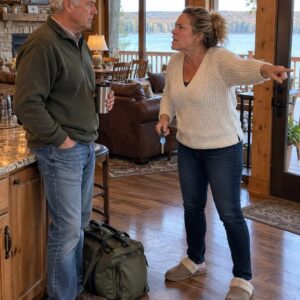
The days that followed felt less like an explosion and more like a power outage. Everything that had been humming—plans, assumptions, the unspoken hierarchy of who got to decide what—went still. Kevin didn’t yell. He didn’t demand apologies or explanations. He just started answering questions differently. “No, Mom’s not moving.” “No, we’re not signing anything.” “No, Christmas isn’t a negotiation.” Tiffany tried to regroup, looping in her parents, her brother, anyone who might help restore the narrative where I was selfish for wanting my own keys in my own lock. Their messages arrived in a chorus of condescension: Surely you don’t want to burden Kevin forever. Surely you know this house is too much for you alone. Surely you understand it’s just practical.
But practicality, I realized, had become their polite word for erasure.
They left two days before Christmas. No scene, no suitcases flung down the stairs. Just Kevin loading their things into the car with the quiet efficiency of a man who had decided, finally, which side of the line he was standing on. Inside, the house exhaled. My remaining guests moved through the rooms without performance, drifting toward the kitchen because they wanted to, not because anyone needed a photo of it. Kevin rinsed plates and set them in the rack with a care that felt almost like apology, though he never said the word and I didn’t ask him to.
Later, when the dishes were stacked and the children asleep, I stood alone in my kitchen and touched the crooked magnet on the fridge. It had been the first crack, the first sign that something in my home was being angled without my consent. I thought of all the times I’d swallowed discomfort to keep the peace, how easily a woman can become scenery in her own life if she confuses endurance with love. That night, with the printer’s pages still on the table and my son’s quiet no echoing in the walls, I understood something I had never put into words: a boundary is not a fight; it’s a fact. A home is not stolen in one dramatic act. It’s given away in a hundred small surrenders—until someone finally notices the door and decides to stand in it.