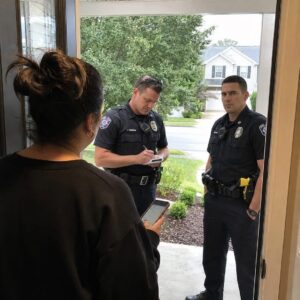
I let her stand on the porch long enough to feel the distance she’d signed her name under. Then I opened the door. Up close, grief had thinned her. She smelled like baby powder and stale coffee, like every exhausted mother I’d ever watched collect a package with one hip balancing a child. Only this time, the fragile thing she was carrying was the story of her own life. She stared at the green accordion file on my table the way people stare at a closed casket—afraid to look, more afraid not to.
“I thought you were punishing us with money,” she said. I slid the typed letter toward her, the one that talked about dynamics and boundaries in Wade’s careful, weaponized vocabulary. “You were punishing me with access,” I answered. “There’s a difference.” She covered her face, shoulders shaking, and for a moment I saw the seven-year-old who’d once lost her mitten and blamed herself for winter. I reached for her hand. Not to erase what she’d done. To mark that she had finally stopped defending the lie.
In the months that followed, consequences arrived the way winter mail does: slowly, relentlessly, addressed to every name involved. The bank cleared my record and locked Wade’s account in an investigation that bled into his credit, his job, his marriage. Caroline learned how to say sentences she’d never imagined she would need: “I need a custody schedule.” “My mother is not your resource.” “No.” Sometimes she said them from my couch at midnight, May asleep on her chest, Hudson’s crayon drawings spreading across my coffee table like small, bright affidavits that life was still happening. I changed passwords, wills, power of attorney, the quiet architecture of who could reach into my life without knocking. Each signature hurt. Protecting myself from my own child’s choices felt like amputating a limb to save the body. But every time doubt crept in—every time that first text echoed, You’re choosing yourself over your own grandchildren—I opened the file and read the dates. Paper does not hate. It remembers.
The day the bank’s final letter arrived, exonerating me in a paragraph of dry legal language, Hudson climbed onto the bench Royce once built and declared me “Grandma Pirate” because of the eye shield I’d worn. His drawing showed us all in front of my house: four stick figures, one big eye, one small, a tiny flag, a crooked car. No Wade. Just the people who were actually there. Caroline watched me laugh until I had to sit down. “I almost let him make me lose you,” she said. “You didn’t,” I told her. “You did make me learn to stop losing myself.” She nodded, understanding that this, too, was an inheritance: a mother who would still love her, but no longer at the cost of her own safety.
Outside, the mail truck moved from house to house, steady as breath. For years I had believed love meant being like that—reliable to the point of invisibility, always showing up, no matter how badly the door on the other side treated the knock. Now I know better. Love is not the absence of boundaries. Love is the courage to draw them before someone else writes your life in their handwriting. It is the strength to keep a record when memory wants to soften, to answer the bank honestly with a stranger listening, to tell your daughter to take the children home while you finish reporting a fraud she helped unlock. I am still Margaret. I am still a mother, a grandmother, a woman who once walked streets in every kind of weather. But I am no longer automatic. And the hill I chose to die on was not myself over my grandchildren. It was this: that they grow up knowing love is generous, yes—but never blind, never silent in the face of harm, and never again signed in my name without my consent.