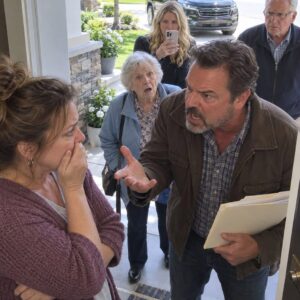
The judge’s ruling was swift and mercilessly logical: twenty years of Deborah paying taxes, fixing leaks, painting that soft cream porch had ripened into legal ownership. On paper, the house was hers, had been hers in every way that counted. I felt the loss like a second funeral; the deed slipping from my fingers might as well have been my father’s hand. But when I looked at her across the courtroom, there was no victory in her face—only a grief that looked unnervingly like my own. Two women who had loved the same difficult man, turned into opponents because he’d never found the courage to put us in the same room while he was alive.
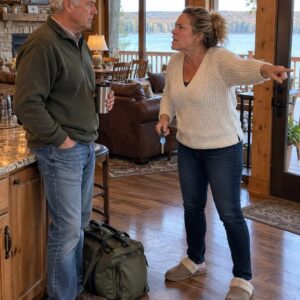
Back at the house, I packed to leave, fingers numb on the suitcase handle, ready to abandon the only place that still smelled faintly of him. Deborah’s voice stopped me at the door, stripped of all its sharpness. She didn’t talk about winning. She talked about missing my first steps in that front room, about birthdays spent imagining me at a grave that should never have existed, about thirty years of rehearsed apologies with no audience. Then she said the one thing my father never had: “Please don’t go.” The suitcase fell. I crossed the room and held my mother for the first time in my life, both of us shaking with a grief that finally had somewhere to go.
The house became something else after that—not a prize, not evidence, but a workshop for a very late, very fragile kind of love. We learned each other in clumsy increments: how she took her tea, how I liked my coffee, when to leave the other alone. Some days we failed and retreated to opposite ends of the hallway; most days, slowly, we failed a little less. My father’s reasons stayed buried with him—why he told me she was dead, why he left her this house yet never let her back into our life. I stopped expecting those answers to rise from the grave.
What I did come to understand was this: the house had never really been his last gift. It was only the wrapper. Inside it was the thing he must have known I needed more than a roof or an inheritance—a path back to the woman he couldn’t forgive but couldn’t quite erase. That path was crooked, cruel at times, paved with lawsuits and sleepless nights and mud-streaked dresses, but it ended with a word I had never spoken to anyone living: “Mom.” In the end, nothing important hinged on whose name sat on the deed. Family lived in the harder work: setting down old weapons, forgiving what could be forgiven, carrying what could not, and choosing—on an ordinary morning in a house full of ghosts—to stay.