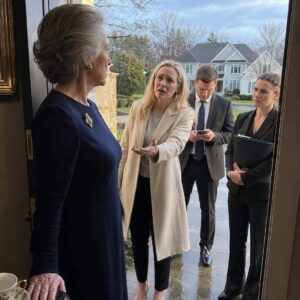
They came in a rented sedan, Veronica’s sunglasses reflecting my house like a prize on a game show. She hugged me with arms that smelled of expensive lotion and impatience, her gaze skating over my furniture, my walls, the framed photos of Diane as if she were reading a balance sheet. On their second visit, they brought an entourage: an attorney with a sympathetic frown, a social worker with a clipboard, a geriatric specialist armed with forms and a court order. The questions were simple—dates, presidents, the year we bought the house—yet I could feel the trap tightening with every correct answer, because the test was never about my mind; it was about whether I would surrender the keys. While I recited facts of my own life, Veronica drifted through my home like a realtor at a pre-listing walkthrough, fingers grazing the piano, Diane’s reading chair, the door to the basement where our safe sat humming in the dark. When the evaluation ended and the lawyer began to circle the phrase “managing your affairs,” I told them it was time to make a call. The doorbell rang as if on cue.
Harold, my attorney, stepped in first, his briefcase heavier than it looked. Behind him came Marcus Webb, the private investigator Diane had hired in secret, and Detective Okafor from financial crimes, badge glinting like a new kind of sunrise. Marcus laid out photographs on my coffee table: three older men, three wedding days, three probate filings. Next to each husband’s smiling face, he placed a guardianship order, then a death certificate, then bank statements charting the same pattern—funds consolidated, assets “restructured,” estates drained into accounts where Veronica’s name bloomed like mold. Harold produced certified transcripts, recordings, and sworn affidavits. Then he pressed play on Diane’s final insurance policy: Veronica’s voice, captured in a quiet restaurant, discussing me as “the last big opportunity” before I “slip far enough that nobody argues with the paperwork.” I watched my son’s face as the woman he’d married was dismantled not by accusation but by evidence—his pupils shrinking, his jaw working soundlessly, the scaffolding of his denial collapsing under the weight of his mother’s foresight. When Detective Okafor cuffed Veronica and read her rights, she twisted toward Darnell and hissed, “Don’t let them do this to us.” For the first time in years, my son looked directly at the truth instead of around it. He opened his mouth, then closed it. The silence that followed was not cowardice; it was the shattering of an illusion he’d chosen over his own mother until it was too late.
In the months that followed, the fortress Diane built revealed itself room by room. Her color-coded binders, meticulous spreadsheets, and quietly notarized statements became a map other families used to reopen “unfortunate” cases that had always smelled wrong but died in the airless language of paperwork. Veronica took a plea: twelve years, restitution, no more husbands. The checks that arrive now—small, staggered, bloodless—can’t repay the years stolen or the funerals attended by predators masquerading as widows, but they exist because my wife refused to let love be naive. Darnell moved back to Detroit alone, into an apartment that doesn’t pretend to be anything grander than a second chance. On Sundays, when I invite him, he drives out, carrying groceries instead of expectations. Sometimes, as he stands at the sink washing dishes he once would have left for his mother, I see the boy from the photographs—knees dirty, eyes wide, desperate for approval. Other times I see the man who let his phone go to voicemail while his mother’s heart failed in the next room. I have learned that both versions are true, and that forgiveness lives, if it lives at all, in the narrow space between them.
I do not “move on” from Diane; I move within the architecture she left behind. Her glasses still rest on the nightstand, arms open like they’re waiting for her face. The last crossword she started sits on the kitchen table, three clues short of complete. Beside it, a basil plant Darnell brought one Sunday leans toward the same window where she used to drink her morning coffee and quietly plan how to outmaneuver the woman who smiled at our Thanksgiving table with a predator’s patience. Grief, I’ve learned, is not a door you walk through and close; it is a floorplan you memorize—the step that creaks, the corner that collects shadows, the room you avoid after dark. On the worst nights, when the clock in the living room ticks like a distant gavel and the refrigerator hum sounds like someone whispering my name, I take out her last letter. It ends with a line that once felt melodramatic and now feels like an engineering report: Every brick of it was love.
Only now do I understand the scale of what she built—trusts and titles, recordings and reports, a maze of contingencies designed so that anyone who came for me with hunger in their eyes would find themselves trapped in her design instead. I have forgiven Darnell the only way a wounded parent can: not with a sweeping gesture that erases the past, but with boundaries that honor it. Forgiveness, I’ve discovered, is not the return of keys; it is the decision not to let bitterness inherit everything. He sets the table without being asked. He asks about my day and waits for the answer. None of that resurrects the woman who saw the danger he refused to see, or erases the message he didn’t answer as she lay dying. But it is movement, and movement is all the living are entitled to demand from one another. Each night, when I turn off the kitchen light and climb the stairs, her letter folded in my pocket like a deed, I am not walking into an empty house. I am walking through proof that love, done right, is more than a feeling or a vow. It is a plan drawn in ink, tested against the worst in people, and built to stand when even the builder is gone.