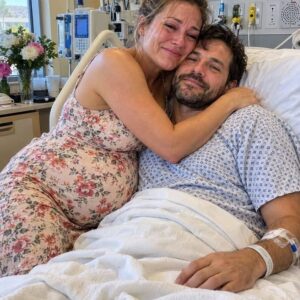
Later, when Ethan filled our cabin doorway, eyes swollen and throat working around words he couldn’t yet say, I recognized the same terror I’d seen once in David’s face under fluorescent hospital lights. Ethan handed me his phone like a confession, then looked away while I read the thread that had turned him from judge to witness: the nurse with the butterfly clip calling a code; David memorizing the pattern of ceiling tiles while they wheeled me away; the surgeon explaining how close “almost” can come to “never.” “She didn’t bounce back,” one text said. “She crawled back. On her body, not yours.”
When he finally asked to see my scar, he stared at it with reverence that hurt worse than his earlier disgust. “Did you almost die… for me?” he whispered. I told him yes, and the word shattered him. His apology came in choking sobs, in the way his arms wrapped around the softness he’d mocked, in the trembling promise that he would never speak about my body like that again—to anyone. The next morning, when I reached for my cover-up, his hand stopped mine. “Please don’t hide,” he said. “Not because of me.” So I walked to the pool bare-armed and bare-bellied, the sun finding every place I’d once disguised. Ethan stood beside me, his arm firm across my shoulders, insisting on the front row of the photo. Years later, long after the lawn-mowed penance and the locker room crusade against boys who rated mothers’ bodies, I understood what truly changed that day. My scar had always been proof that I survived bringing him here; now it was proof that he’d learned how not to be another wound. In the end, it wasn’t my body that needed defending—it was the story written on it, finally read aloud, until love had no choice but to stand in the unedited light.