In the weeks after that parking-lot explosion, my life split cleanly in two: the gray couch in Dr. Osei’s office where Landon and I sat at opposite ends, and the diner booth where Caleb and I met over cheeseburgers and coffee. In therapy, Landon finally named the ghost I’d been living with: a nine-year-old boy watching his mother leave for her first love, condemned to a kitchen table of cold dinners and quiet rage. Every time I’d said “Luke,” he’d heard that front door closing again. I confessed how I’d trimmed my days down to fit inside his fear, how I’d stepped over that crack for fourteen years until my feet ached. He admitted that finding Caleb had been worse than finding an affair; betrayal, he said, he understood, but a whole hidden life built before him—hidden because of him—was a different kind of wound.
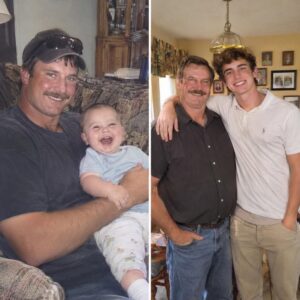
While we untangled that, Caleb kept showing up: in the café, at the diner, then in our garage, sleeves rolled, hands greasy, shoulder to shoulder with the man who’d once demanded I give him up. Joanne, small and fierce in her hospital bed, squeezed my hand and said, “You picked us. We never forgot that.” At her backyard birthday, the oak tree from their adoption letter stood solid, a tire swing swaying where Ray had once tied the rope. I watched Landon and Caleb argue about burger technique like they’d been doing it for years, their laughter overlapping, and felt something inside me unlock. Weeks later, when Tom Petty came on in the car, Landon didn’t turn it down; he turned it up and asked to hear everything—Luke, the laundromat apartment, the Tuesday in March at 4:12 a.m., the nurse with the camera, the four-hour letter to “the people who will raise my son.” He listened all the way home. In the dark driveway, he showed me the two photographs he now kept together: me at twenty-five with a newborn, and us at Joanne’s party—Caleb at the grill with him, and me in the background, watching them with the same unguarded love. “For the truck,” he said, sliding them into the glove compartment. “So I don’t forget there’s room. There was always room. I just didn’t know it.” Inside, I chopped onions and set them aside, then smiled and cooked without them. Some compromises we kept. Others, we finally let go. Caleb came by Saturday with a rebuilt starter and a six-pack of cheap beer; Landon met him in the garage, calling, “You’re late, kid,” like it had always been this way. And when my son stepped through our doorway, I didn’t lower my voice or hide my joy. I said his name out loud, in my own kitchen, and nobody flinched.